
PromptScout Blog
Which Questions Should You Track in ChatGPT?
Choose ChatGPT questions that reflect buyer decisions. Keep a fixed question set, review gaps, and separate question coverage from answer counts.
Published

Founder
Building PromptScout to help teams understand how AI assistants cite, mention, and recommend their brands.
Your brand in AI answers
See where AI recommends your competitors.
Start with a free visibility check. Paid plans add monitoring; Growth adds Opportunities.
Paid monitoring: ChatGPT Gemini AI Overviews Perplexity Bing Copilot
Track questions that reflect a buyer's decision, then keep their wording fixed during reporting. Add a question when it covers a use case the current list misses. Artificial intelligence (AI) monitoring is easier to interpret when each question has a clear purpose and the team knows what it would investigate in the answer.
Summary
Start with customer questions, sales objections, and the problems your product solves. For each candidate, record the buyer, the decision, and the source of the idea. Then name what you would inspect if the answer were inaccurate or incomplete: a product claim, comparison page, cited source, or missing explanation. Questions with no clear business use can stay in a separate research list.
Generative engine optimization (GEO) depends on relevant content and useful evidence, so a monitoring list should help find specific gaps. Keep discovery, comparison, and problem-solving questions distinct. A longer list helps only when it adds a decision worth reviewing. More responses to the same question can broaden the engine or time coverage, but they do not add another buyer need to the set.
Start With Buyer Questions
For a small agency, start with the client’s sales calls, support requests, and product research. Remove private details before using that language in a question. Keep the constraints that affect the choice: who is buying, the job they need to do, and any relevant limits. A question about booking tools for a mobile dog groomer is more useful to that business than a broad request for the best software. The narrower question gives the team a specific use case to check.
Avoid wording that tells the model which brand to praise or which features to assume. If the question already supplies the desired conclusion, the answer says little about discovery. Keep direct brand questions for checking descriptions and product facts. They remain useful, but their results belong beside other branded questions rather than in the rate for unprompted brand presence.
Cover Different Decisions
For a mobile dog groomer, “Which booking tools suit a mobile business?” tests discovery. “How does a booking app compare with a shared calendar?” tests tradeoffs. “How can I reduce missed appointments?” tests whether the advice connects a problem with relevant capabilities. These questions give the reviewer different jobs, even though they concern the same product category.
Keep a question when its answer could reveal a distinct gap. If several questions lead to the same page and test the same claim, review whether they add meaningful coverage or simply vary the wording. You do not need equal-sized groups. You need enough detail to explain why each group matters to the buyer and which decisions remain outside the report.
Find Ideas Without Assuming Demand
Customer questions establish relevance to your audience, and search data can reveal related language. Neither gives a direct count of how often people ask a question in ChatGPT. Keep the source of each idea in the log, including whether it came from a customer theme, a search query, or the team's own research. That lets a reviewer distinguish observed demand in a source from a useful question you chose to test.
Tools can help with discovery as well as tracking. Ahrefs Brand Radar separates its existing response index from custom prompt tracking. Use index findings to investigate possible gaps, then decide which questions belong in your own set. A question appearing in a tool's dataset does not by itself establish its value for your audience or its frequency across all ChatGPT use.
Selection Checklist
For each question, save the exact wording, buyer, purpose, origin, and inclusion reason. Name the claim or page you would inspect after an inaccurate answer. Keep excluded candidates with a brief reason, such as an overlapping decision or a use case the product does not serve. This prevents the same rejected idea from returning at each review and makes selection less dependent on who happens to maintain the list.
Record the collection surface, exposed model, available settings, and conversation context. A question in a fresh chat differs from a follow-up after a product discussion. Keep wording changes, research questions, and retired questions in a version history. The log should make it possible to tell whether a later change came from the observed answers or from a change in what you asked.
More Answers Don't Add Questions
Our snapshot contains 15 successful responses to 3 questions across 5 providers. The providers answered the same questions. That broadens the engine comparison without adding buying situations. For a ChatGPT report, use the ChatGPT records; adding other engines' answers to the total does not increase what you have observed in ChatGPT.
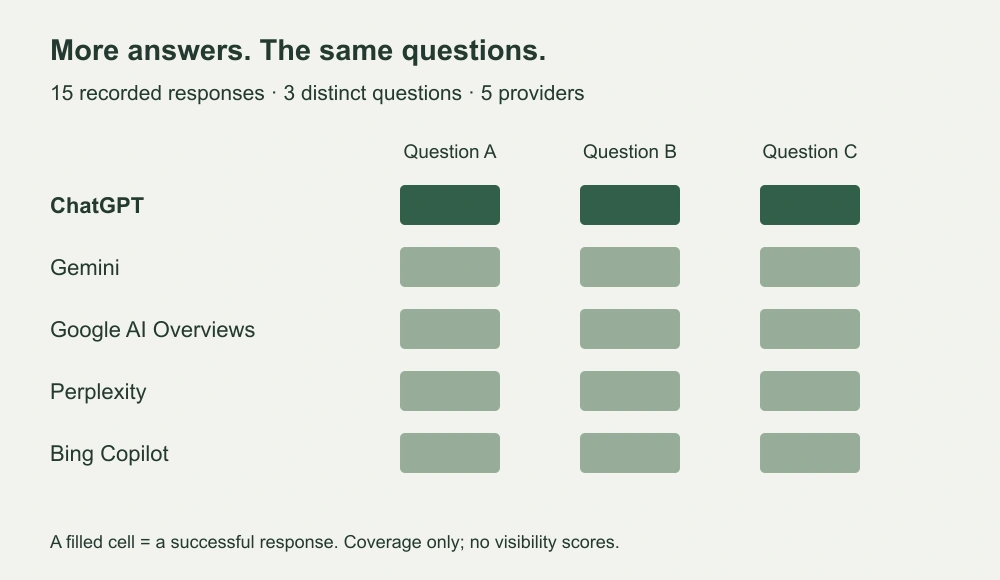
Each cell represents a successful response to the same anonymized question across providers. The chart measures collection coverage, not brand presence. Before expanding collection, review whether the missing evidence concerns another engine, another observation window, or another buyer decision. Those gaps call for different changes, and a larger total answer count can hide which one remains unresolved.
Review the Answers and the List
Do not remove a relevant question because your brand is absent. Check whether the answer describes the use case accurately and whether the cited pages support its claims. If a useful fact is missing from your own content, add it where the buyer would expect to find it. If the product does not fit the request, keep that limit visible instead of forcing a content task.
Revisit the list when the audience, product, or positioning changes. Retire questions whose purpose has disappeared and keep new wording outside the current reporting set until review. Compare unchanged questions if they still cover the same decisions; otherwise, start a new baseline. A clear version boundary makes the next report more useful than a continuous line built from different question sets.
Using PromptScout
In PromptScout, maintain questions in Prompts and inspect completed runs in Monitoring. Keep selection reasons and version history in your worksheet. Record brand presence separately from displayed citations, then use the next scheduled observation to check the same questions. Keep the original reason for tracking a question visible while deciding whether an answer calls for a page edit, source review, or no action.
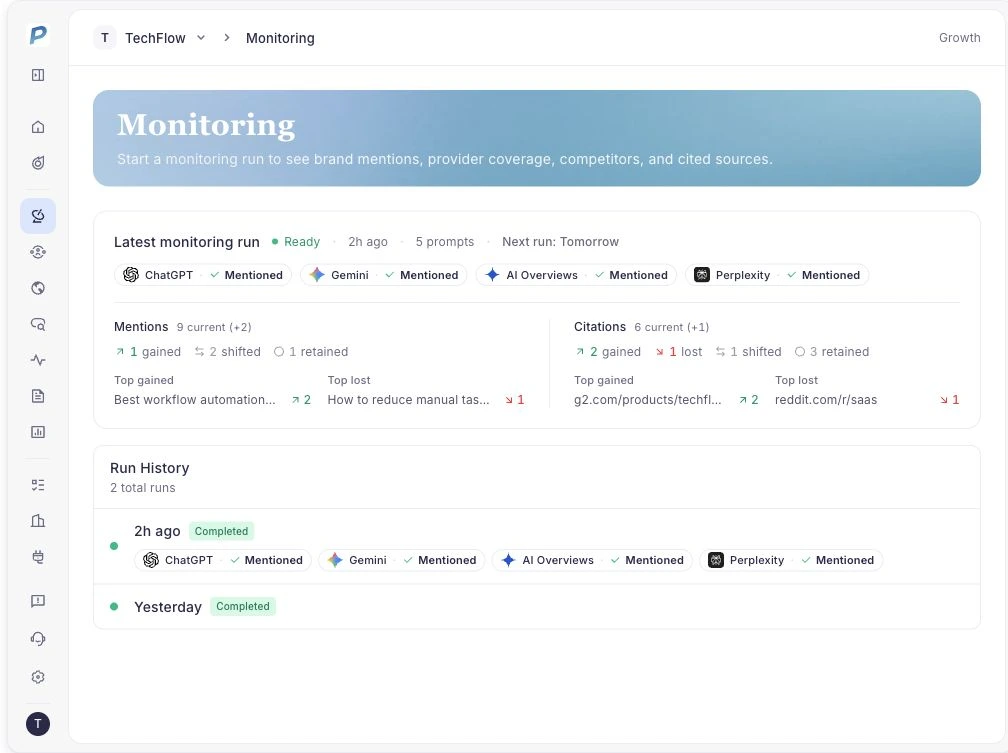
Example from the PromptScout application.
Notes on the data
The chart contains 15 successful responses to 3 distinct questions. ChatGPT, Gemini, Google AI Overviews, Perplexity, and Bing Copilot each supplied 3 responses to the same question set. Collection took place on September 6, 2026, between 00:01:33 and 00:01:55 in Coordinated Universal Time (UTC). All recorded responses contain answer text. The letters identify questions consistently across providers without exposing their wording.
A filled cell counts a response, regardless of whether a brand appeared or a page was cited. The snapshot covers a single window and a selected question set; it does not measure question demand, repeated-answer stability, or customer behavior. The chart therefore distinguishes question coverage from provider coverage. It supplies no estimate of visibility growth or the effect of changing a page. Private questions, answers, and customer details are omitted.